
 UAE
UAE
 KSA
KSA
 Kuwait
 Book Online
 WhatsApp Us
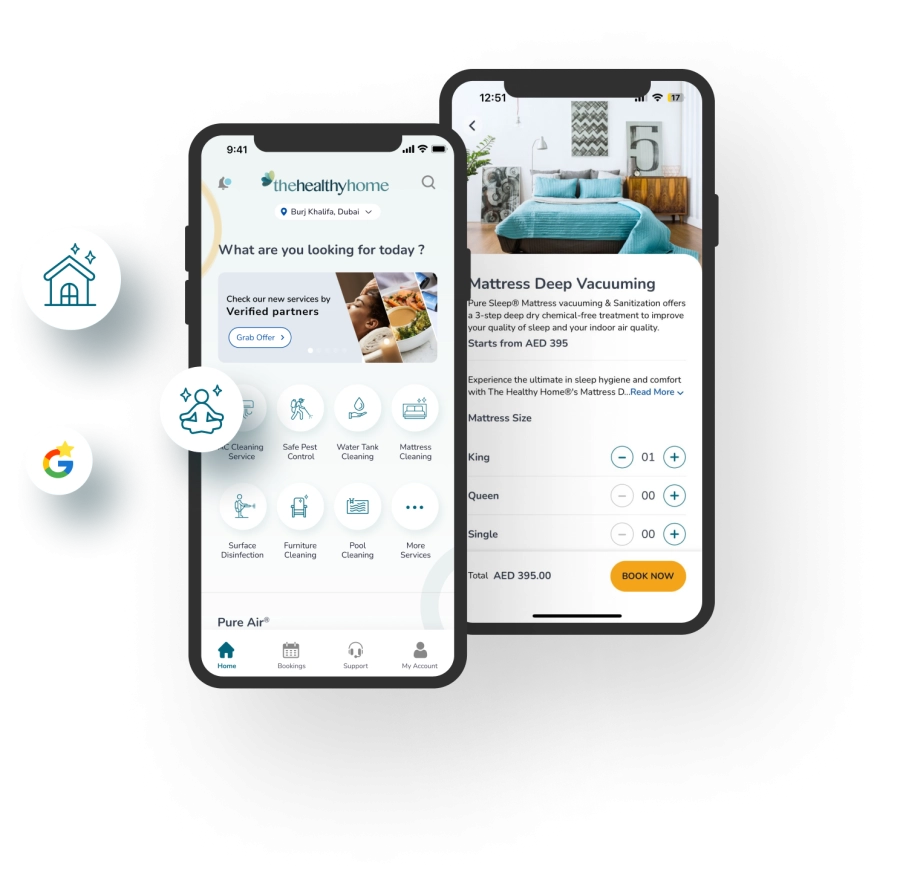
Now Live: The Healthy Home® App
Experience The Healthy Home®, your premium choice for home services. Download the app to easily book, schedule, and relax with the care your family deserves.




AC coil cleaning removes dust and debris from evaporator and condenser coils, improving heat transfer and cooling efficiency. Our NADCA-certified technicians inspect and clean coils safely. If cooling drops or buildup is visible, an inspection can help determine if cleaning is needed. Call our wellness consultant at 800 72648493 to book your service today!
Professional AC coil cleaning focuses on the components responsible for transferring heat through your HVAC system. The evaporator coil absorbs heat from indoor air, while the condenser coil releases that heat outdoors. Dust and debris accumulated on either coil can interfere with this process.
Our technicians inspect the accessible areas of the air conditioning system before selecting the appropriate cleaning method and equipment. The service is designed to remove accumulated contaminants from the coil surfaces without unnecessarily damaging the delicate fins.
Clean coils allow the system to exchange heat more effectively. When contamination is restricting heat transfer, professional cleaning can support cooling efficiency, consistent airflow, and overall HVAC performance.
The service is suitable for residential and commercial properties, including villas, apartments, offices, and larger facilities. The cleaning approach is determined by the condition, accessibility, and configuration of the HVAC system.


Our AC coil cleaning service starts with an HVAC inspection to assess the condition and accessibility of the evaporator and condenser coils.
01. HVAC inspection
Our technicians inspect the accessible cooling components and identify visible dust, debris, corrosion, fin damage, or other conditions that may affect cleaning.
02. Coil preparation
The work area and surrounding components are protected before cleaning begins. The appropriate coil cleaning equipment and cleaning method are selected based on the coil condition and system configuration.
03. Evaporator coil cleaning
The accessible evaporator coil is professionally cleaned to remove accumulated dust and debris from the coil surface and surrounding accessible areas.
04. Condenser coil cleaning
The accessible condenser coil is cleaned to remove accumulated outdoor dust, dirt, and debris that may interfere with heat dissipation.
05. Component checks
Relevant accessible components are visually checked as part of the service. Where appropriate, the condition of the coil fins, surrounding components, and visible system areas is documented.
06. Service report
You receive before-and-after service documentation along with any relevant observations identified during the inspection.
The evaporator coil and condenser coil are essential to the AC heat exchange process. The evaporator coil absorbs heat from indoor air, while the condenser coil releases that heat outside through the cooling cycle.
When dust and debris accumulate on either coil, they can act as a barrier to effective heat transfer. The system may then need to operate for longer or work harder to achieve the desired indoor temperature.
The refrigerant carries heat between the indoor and outdoor sides of the system, but the coils must be able to transfer that heat effectively. If the coils are contaminated, the cooling system can lose efficiency even when other components are functioning normally.
This can affect overall HVAC performance and place additional operating demand on components such as the compressor. Regular inspection and appropriate coil cleaning can therefore form an important part of maintaining a reliable cooling system.
In Abu Dhabi, airborne dust and the environment around outdoor condenser units can contribute to gradual buildup. Properties with frequent AC use or significant dust exposure may benefit from more regular HVAC inspections.
The two coils perform different jobs within the same cooling cycle. Understanding the difference helps explain why both require appropriate maintenance.
| Factor | Evaporator Coil | Condenser Coil |
|---|---|---|
| Location | Indoor unit | Outdoor unit |
| Role in cooling cycle | Absorbs heat from indoor air | Releases heat outside |
| Refrigerant function | Refrigerant absorbs heat as it changes state | Refrigerant releases heat as it condenses |
| Primary process | Heat absorption | Heat dissipation |
| Air interaction | Indoor air passes across the coil | Outdoor air passes across the coil |
| When dirty | Can reduce heat absorption and cooling performance | Can reduce heat dissipation and increase system workload |


The Healthy Home® provides NADCA-certified AC coil cleaning services, using specialized coil cleaning equipment and structured HVAC inspections to support residential and commercial properties across Abu Dhabi.
With over 12 years of experience in HVAC system cleaning, we work across a wide range of system types, including villas, apartments, offices, and commercial buildings. Each service begins with an inspection to assess coil condition and determine the appropriate cleaning approach based on accessibility and level of contamination.
Our cleaning process focuses on the safe removal of accumulated dust and debris from evaporator and condenser coils while protecting delicate coil fins and surrounding HVAC components. All findings observed during the service are documented to support transparency and help customers understand the condition of their system.
If your system shows reduced cooling performance, visible coil buildup, or extended operating cycles, an inspection can help determine whether NADCA certified coil cleaning is required.
AC coil cleaning is the process of removing accumulated dust, dirt, and debris from the evaporator and condenser coils of an air conditioning system. Clean coils allow more effective heat transfer through the cooling cycle and can help the HVAC system maintain its intended cooling performance.
Dirty coils can reduce heat transfer and make the air conditioning system work harder to achieve the desired temperature. Depending on the condition of the coils, this can contribute to reduced cooling performance, longer operating cycles, and additional strain on components such as the compressor.
Common signs include reduced cooling, longer AC running cycles, weaker airflow, visible dust or buildup on accessible coil surfaces, and increasing energy consumption. Frost or ice on an evaporator coil can also indicate an HVAC issue, although the cause may be related to airflow, refrigerant, or another system problem. An inspection is recommended before assuming coil cleaning is the solution.
AC coil cleaning is an important part of HVAC maintenance, but it is not necessarily included in every maintenance package. Maintenance services vary, so it is worth confirming whether the service includes cleaning of both the evaporator coil and condenser coil, rather than only inspection or basic AC servicing.
The evaporator coil is located in the indoor unit and absorbs heat from the air passing through the AC system. If the coil becomes coated with dust or debris, heat absorption can be affected, which may result in weaker cooling and reduced HVAC performance.
The appropriate cleaning frequency depends on the property's environment, AC usage, dust exposure, and condition of the HVAC system. For many properties, annual AC coil cleaning can be considered as part of routine maintenance. Properties exposed to significant dust or with frequent AC usage may require more frequent inspection and cleaning.
Yes. When dust and debris are affecting the coils, professional cleaning can restore more effective heat exchange between the refrigerant and surrounding air. This can help the cooling system transfer heat more effectively and support improved cooling efficiency and HVAC performance.
Professional AC coil cleaning typically begins with an HVAC inspection to assess the condition and accessibility of the coils. Specialized coil cleaning equipment is then used to remove accumulated contaminants from the evaporator and condenser coils. Depending on the service scope, airflow testing and checks of cooling performance may also be carried out before or after cleaning.
Certified for top-quality air duct cleaning and healthier indoor air.
Certified for expertise in indoor air quality and promoting healthier indoor spaces.
Certified for top cleaning and hygiene standards by ISSA.
Certified to improve indoor air quality for a safer environment.
Reach out to us through any of these channels
 Give us a Call
 WhatsApp Support
 Send us an Email