
 UAE
UAE
 KSA
KSA
 Kuwait
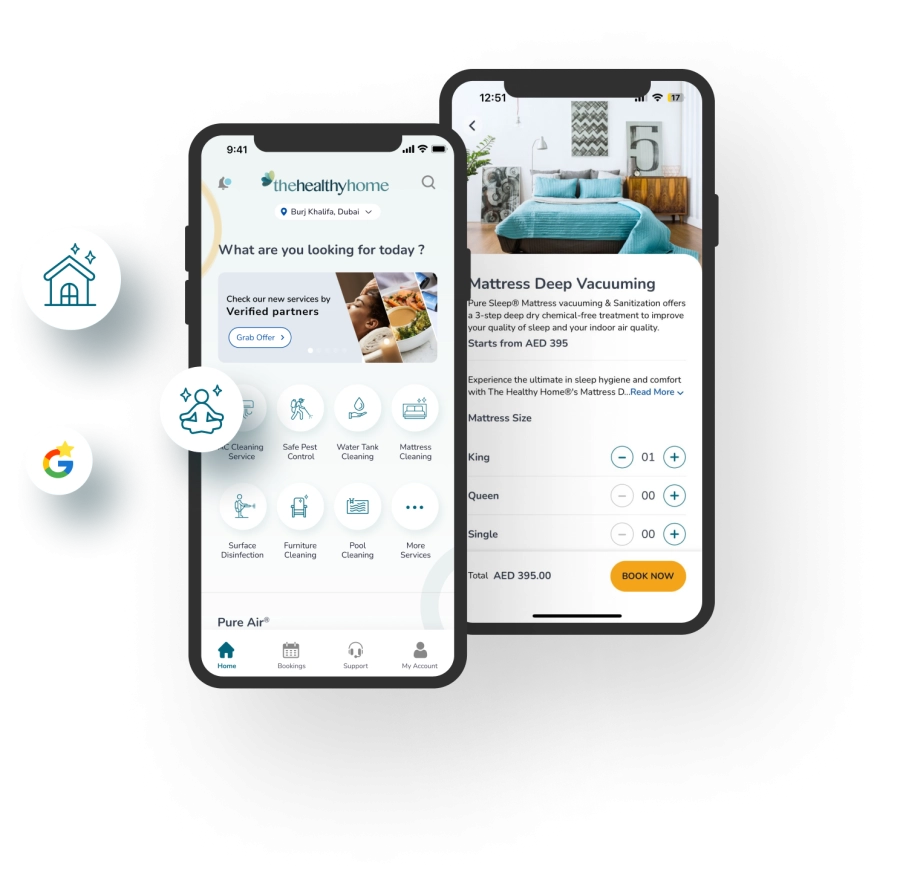
Now Live: The Healthy Home® App
Experience The Healthy Home®, your premium choice for home services. Download the app to easily book, schedule, and relax with the care your family deserves.




)
Professional AC cleaning uses specialized equipment, refrigerant handling expertise, and deep component access that DIY methods cannot replicate. Professionals clean internal coils, drain lines, and refrigerant circuits while adhering to safety regulations. DIY cleaning typically addresses only filters and external surfaces, missing 80 percent of contaminants that reduce efficiency and lifespan.
Air conditioning systems are complex machines. Yet many homeowners assume that regular filter changes and occasional surface cleaning constitute adequate maintenance. This assumption costs money in the long run.
The truth is that professional AC cleaning and DIY maintenance operate in completely different leagues. They access different parts of the system, use different tools, and achieve different results. A homeowner armed with a vacuum and brush cleans maybe 20 percent of what a professional technician cleans.
Understanding these differences helps you make informed decisions about when DIY is sufficient and when professional help becomes a wise investment. In Dubai and Abu Dhabi, where extreme heat drives AC systems to work year-round at maximum capacity, the gap between maintenance approaches directly translates to system lifespan and energy costs.
Homeowners can successfully manage basic maintenance tasks that don't require system disassembly or refrigerant handling:
These tasks are valuable and should be part of routine maintenance. They prevent some efficiency loss and reduce strain on components. However, they represent only surface-level cleaning.
Professional equipment and training unlock access to critical system components:
Attempting DIY access to these components risks damage to refrigerant lines, coil punctures, and electrical hazards. More importantly, improper handling of refrigerants violates environmental regulations and results in fines.
Professional technicians use equipment unavailable to consumers. This equipment serves specific purposes that directly improve system performance:
1. Coil cleaning equipment: Pressurized chemical coil cleaners and foaming agents that dissolve mineral buildup, mold, and algae without damaging aluminum fins. Industrial vacuum systems extract water and dissolved contaminants without saturation.
2. Refrigerant diagnostics: Electronic leak detection equipment identifies microscopic leaks. Recovery machines safely extract and store refrigerant. Evacuation pumps remove air and moisture from lines. Precision scales measure exact refrigerant quantities for recharge.
3. Ductwork inspection: Video camera systems mounted on flexible cables allow technicians to see inside ducts without tearing apart walls. Duct cleaning equipment uses high-pressure air whips and agitation to dislodge embedded dust and debris.
Professional professional AC maintenance follows a structured protocol that addresses the entire system:
1. System inspection and diagnostics. Technicians test cooling capacity, measure temperature differential across coils, check pressures, and identify leaks or component wear.
2. Filter and intake cleaning. High-efficiency filters are replaced. Return air ducts are vacuumed to remove settled particles that restrict airflow.
3. Evaporator coil deep cleaning. The indoor cooling coil is chemically treated and rinsed. This removes the mold and algae that develops during humid months and restricts heat transfer.
4. Condenser coil treatment. Outdoor condenser fins are sprayed with specialized cleaner, rinsed under pressure, and treated to prevent corrosion in salty gulf air.
5. Blower and fan motor cleaning. Dust and debris are carefully removed from fan blades and motor housing. Bearings are lubricated where appropriate.
6. Drain line treatment. Condensate drain lines are flushed and treated with algaecide to prevent future blockages and odor issues.
7. Refrigerant testing and recharge. Pressure tests identify leaks. Refrigerant is recovered, the system is evacuated, and precise quantities are charged based on system specifications.
8. System performance testing. Final checks confirm temperature differential, discharge air temperature, and proper operation across all modes.
This comprehensive process typically takes 2 to 4 hours depending on system size and contamination level.
The difference between professional and DIY cleaning translates directly to measurable performance improvements:
| Performance metric | Before professional cleaning | After professional cleaning | Improvement |
|---|---|---|---|
| Cooling capacity (BTU) | 12,000 | 13,200 | 10 percent increase |
| Temperature differential | 8°C | 12°C | 50 percent improvement |
| Energy consumption | Baseline | 20-25 percent lower | Significant savings |
| Airflow (CFM) | 250 | 350 | 40 percent increase |
| System lifespan extension | N/A | 3-5 additional years | Deferred replacement costs |
Annual cost for homeowner maintenance:
However, this apparent savings evaporates when system replacement becomes necessary 3 to 5 years earlier than if professional AC filter replacement and cleaning had been performed.
Annual cost for professional AC cleaning and maintenance:
This investment prevents early replacement and extends system life by 40 to 50 percent. A mid-range residential AC system costs AED 15,000 to 25,000 to replace. Delaying replacement by even 3 years saves money when factored against higher energy bills from an inefficient system.
A homeowner using DIY maintenance only might spend AED 150 to 450 annually but faces system replacement at year 8, requiring AED 15,000 to 25,000 investment. The true 10-year cost is AED 3,000 to 6,000 in maintenance plus AED 15,000 to 25,000 in replacement = AED 18,000 to 31,000.
A homeowner investing in professional AC cleaning costs of AED 1,000 to 2,000 annually might spend AED 10,000 to 20,000 in maintenance over 10 years but extends system life to year 13, delaying the AED 15,000 to 25,000 replacement cost beyond the 10-year window. The true 10-year cost is only AED 10,000 to 20,000 in maintenance.
Reach out to us through any of these channels
 Give us a Call
 WhatsApp Support
 Send us an Email