Key takeaways

The household products most likely to pollute indoor air are cleaning sprays, air fresheners, bakhoor and incense, scented candles, aerosol sprays, paints, new furniture, pesticide sprays and gas stoves. They release volatile organic compounds (VOCs) or fine smoke particles that build up in closed, air-conditioned homes. Using fewer scented and aerosol products, never mixing cleaners and ventilating after use removes most of the problem.

Some of the strongest sources of chemical pollution in a home sit under the kitchen sink and on the bathroom shelf. Where homes stay sealed and air-conditioned for most of the year, whatever these products release has little chance to escape. Below, our trained specialists explain which everyday products matter most, what each releases and the practical change that fixes it.


Many cleaning, scented and personal care products contain volatile organic compounds, or VOCs. These are chemicals that evaporate at room temperature and mix into the air you breathe. The US Environmental Protection Agency (EPA) found that levels of about a dozen common organic pollutants are 2 to 5 times higher inside homes than outside.


A 2018 study in Science led by NOAA scientists found that consumer products such as cleaners, paints and personal care items now produce roughly half of petrochemical VOC emissions in industrialised cities.


9 common household products that pollute indoor air

1. Cleaning sprays and disinfectants


Surface sprays, bathroom cleaners and disinfectants are among the most used VOC sources in any home, and spraying creates a fine mist that is easy to inhale. Bleach releases chlorine compounds that irritate the airways. The biggest risk is mixing: bleach with ammonia-based glass cleaner produces chloramine gas, and bleach with acidic cleaners releases chlorine gas. Use one product at a time and choose wipe formats over sprays.


2. Air fresheners and plug-in diffusers


Plug-ins and diffusers release fragrance chemicals continuously. Many contain terpenes, the compounds behind citrus and pine scents. Research funded by the California Air Resources Board (CARB) found that terpene-containing products produced formaldehyde and ultrafine particles in rooms where ozone was present. Removing the source of an odour, or switching to low-emission gel-based alternatives, works better than masking it.


3. Bakhoor, oud and incense


Burning bakhoor and oud is part of daily life in many homes and one of the strongest indoor pollution sources in the region. Charcoal-burned incense releases fine particles, carbon monoxide, sulphur dioxide and formaldehyde. A study of 628 homes across the UAE, reported in Science of the Total Environment, linked daily bakhoor burning with more headaches, difficulty concentrating and forgetfulness. Researchers at the UNC Gillings School of Global Public Health recommend electric burners in place of charcoal and better ventilation. Burn smaller amounts and keep it out of bedrooms.


4. Scented candles


Paraffin candles release soot and VOCs, and scented versions add fragrance chemicals on top. Long burns in small closed rooms produce the highest exposure, so trim wicks and burn for shorter periods.

Talk to an Expert

5. Aerosol sprays and personal care products


Hairspray, spray deodorant, perfume and nail polish remover release solvents and fragrance compounds, and the EPA lists aerosol sprays among the main household VOC sources. Switch to roll-on or pump versions, and use sprays in a bathroom with the extractor fan running.


6. Paints, varnishes and adhesives


Fresh paint, varnish and adhesives release the highest VOC levels of any household activity. The EPA notes that during and for several hours after paint stripping, indoor levels can reach 1,000 times background outdoor levels. Choosing non-VOC paint and ventilating for several days afterwards keeps exposure low.


7. New furniture, mattresses and carpets


Pressed-wood furniture, foam mattresses and new carpets release chemicals such as formaldehyde, a process known as off-gassing. Emissions are highest in the first few weeks, so unwrap new items in a ventilated space and air the room well before use.


8. Pesticide sprays and mothballs


Insect sprays, plug-in mosquito repellents and mothballs release chemicals designed to linger, and the EPA lists both pesticides and moth repellents as household VOC sources. Repeated DIY spraying in closed rooms often exposes residents more than a targeted treatment, which is why pest control safety depends on the right product, the right dose and a proper re-entry time.


9. Gas stoves


Gas hobs release nitrogen dioxide, carbon monoxide and fine particles. According to the EPA, indoor nitrogen dioxide levels in homes with gas stoves often exceed outdoor levels. Run the extractor hood while cooking and for a few minutes afterwards.


How to reduce pollution from household products

1. Remove before you replace - Cutting the number of scented products beats buying a new device.


2. Never mix cleaning products - Rinse between products, especially with bleach.


3. Ventilate during and after use - Run extractor fans or open windows for 15 to 30 minutes after cleaning, cooking or burning bakhoor, when outdoor air allows.


4. Choose low-emission formats - Pick fragrance-free and low-VOC labelled products.


5. Store chemicals outside living spaces - Keep sealed containers in a utility area, not bedrooms.


6. Use the right filter - HEPA air purifiers trap smoke particles, but only units with activated carbon absorb chemical gases.


7. Keep the AC system clean - Clean filters and ducts stop residues recirculating.


When to get your indoor air tested

If symptoms continue after cutting back, or you have recently renovated or moved home, measuring the air replaces guesswork. Professional indoor air quality testing measures total VOCs, formaldehyde, fine particles, carbon dioxide and humidity,, showing which rooms need attention first. It is especially worthwhile for homes with newborns or asthma sufferers.


Sources & reference

Explore Our Services
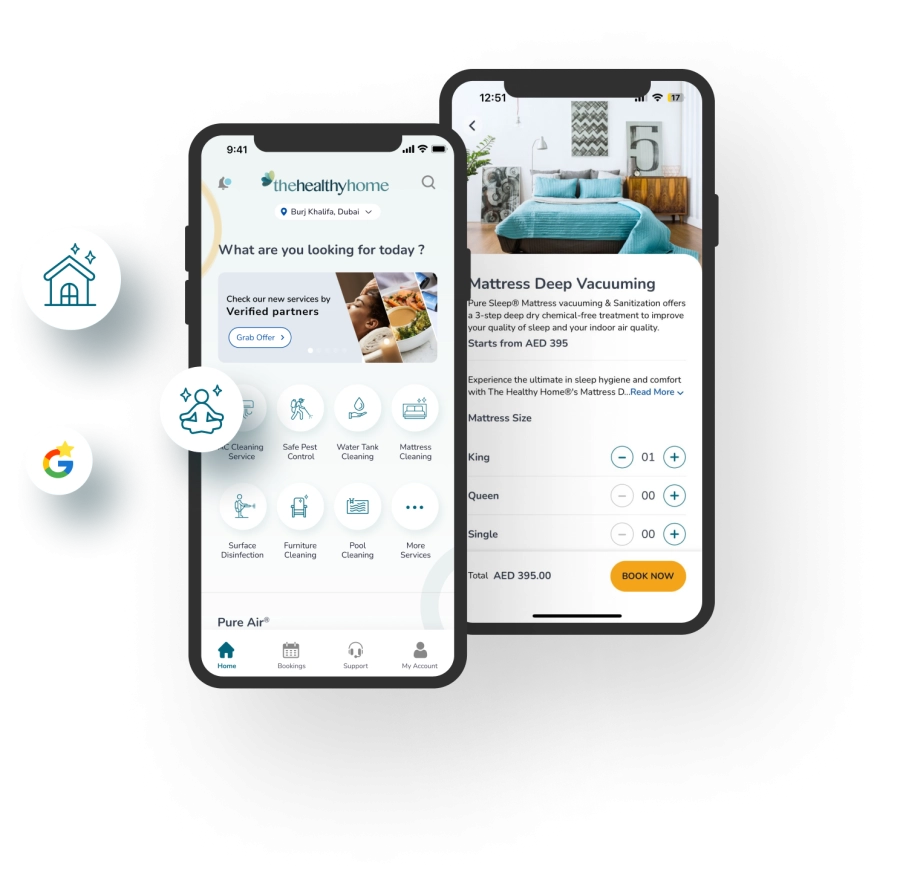
Now Live: The Healthy Home® App
Experience The Healthy Home®, your premium choice for home services. Download the app to easily book, schedule, and relax with the care your family deserves.
Mobile app